The Complete Education Portal

Pallikkutam

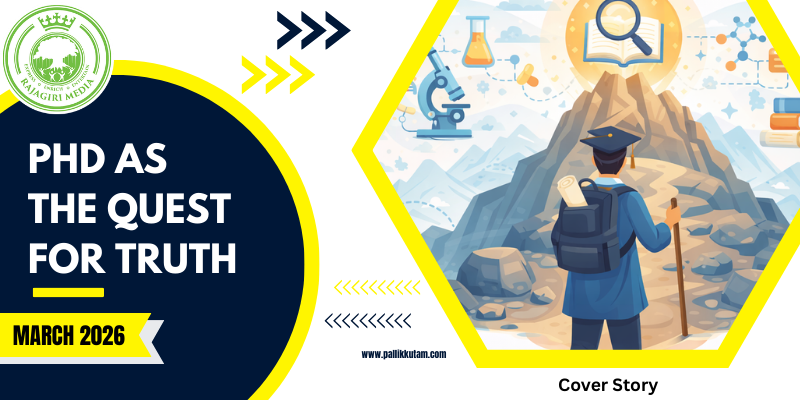
PhD as the Quest for Truth

Research in universities must be a continuous quest for truth meant for protecting and advancing life on the planet, & creation of new knowledge and resources.

This article is available for free. Please log in or subscribe to access all articles.

It is not without reason that those who complete their research in universities obtain a PhD, which stands for Doctor of Philosophy. Research is a quest for truth, and this was the reason why Gundula Bosch, a leading scientist at John Hopkins Bloomberg School of Public Health, wrote in Nature in 2018, that research must promote critical thinking. Philosophy must return to the Doctorate of Philosophy. With that objective, the R3 Centre for Innovation in Science Education was set up in 2017 to develop and disseminate innovative graduate-level programmes, workshops, and resources that emphasise 3 R's : Rigorous research conduct, Reproducibility of scientific methods and findings, and Responsibility of scientists to society. 

"Our offerings are different from others at the graduate level. We have critical thinking assignments in which students analyse errors in reasoning in a New York Times opinion piece about "big sugar", and the ethical implications of the arguments made in a New Yorker piece by surgeon Atul Gawande entitled "The Mistrust of Science." She pointed out that the graduate courses are rigorous in research, scientific integrity, logic, and mathematical and programming skills, which are integrated into students' laboratory and field work.

 Globally, universities are competing to show more research output than others. IITS in India awarded 2259 PhDs between 2020 and 2025, while the total number of PhDs awarded between 2010 and 2019 was only 2376.  However, Dr. Santosh Joseph, Head of Procurement and Governance at Adani Digital Labs, pointed out in a LinkedIn post that the quantitative boom is a massive win for knowledge creation and capacity building; the true measure of success lies in impact. 

"For India and the global economy to truly benefit, it is crucial that the majority of these scholars focus on meaningful, highly relevant research that addresses today's real-world challenges. We need to move beyond the traditional "thesis paper" and translate academic rigour into actionable, scalable solutions."

The Story of Professor Richard Robson

Professor Richard Robson of the University of Melbourne, along with Professor Susumu Kitagawa from Kyoto University and Professor Omar M Yaghi from the University of California, were awarded the 2025 Nobel Prize in Chemistry for their development of metal-organic frameworks. Metal organic frameworks are a new class of solids being developed into gas and energy storage devices, catalytic reactors, and other potentially revolutionary products. The University of Melbourne had published a photo of Professor Robson back in Chemistry class for first-year students a day after the Nobel Prize was announced. Professor Emma Johnston AO, Vice Chancellor of Melbourne University, said that as long as we continue searching for solutions for the world's greatest challenges, fundamental research is still essential. "There are still serious scientific and technological hurdles to overcome. If we are to solve these, it will be drawing on the foundation of long-term fundamental research that universities enable. 

The news of growth in fundamental research in many countries comes in stark contrast to the Indian scenario, where researchers are shifting from academia and finding greener pastures in industry and NGO's, according to Dr. John J Kennedy, former Professor of English and Cultural Studies at Christ University, Bengaluru. He pointed out in a recent article in Deccan Herald that a marginal increase in allocation for education and 11% for higher education does not conform to the aspirational goals of the nation. The 2026-27 Union Budget has seen a policy tilt that frames higher education primarily as a workforce pipeline for industry. The focus is on skill development and vocational integration, giving less emphasis and less dedicated funding to disciplines that foster critical thinking, ethical reasoning, and foundational curiosity-driven research, namely, the humanities, social sciences and pure sciences. These fields are the essential bedrock of a healthy democracy, a nuanced public discourse, and the kind of blue-sky research that leads to transformation. 

The Department of Biochemistry's home page in Oxford University is really quite inspiring. What it says: " We work to understand the mechanisms underlying the fundamental question - what is life? Our approaches span huge scales, from single atoms to entire organisms. We investigate proteins by describing the position of every atom, image individual proteins carrying out their function in living cells, and follow cells as they work together in tissues. This knowledge can then put to work by scientists, medical doctors and businesses to develop new ways of protecting and advancing human life."

This kind of high-quality research involves many exceptionally-skilled people and costs a lot of money, so every year we raise around £12.5million to support our work. This money comes from the UK government, international research councils, UK charities, and industrial sources. Raised in competitions for funding with other scientists from all over the world, it enables us to publish over 250 research studies every year. Because of this, our work is internationally recognised for its impact on human life, and for decades we’ve maintained our reputation as a world-leading centre for biochemistry." 

In a nutshell, research should be a continuous quest for truth in universities. It will enable the development of technologies and solutions to overcome the challenges mankind faces and make the planet sustainable 


Sreekumar Raghavan

Sreekumar Raghavan is an experienced media professional and trainer. He is presently Editor of Pallikkutam, The Education Observer and hosts the monthly event, Rajagiri Round Table Conference.


Download this article in PDF format ↓

Go to index page »

SUBMIT REVIEW