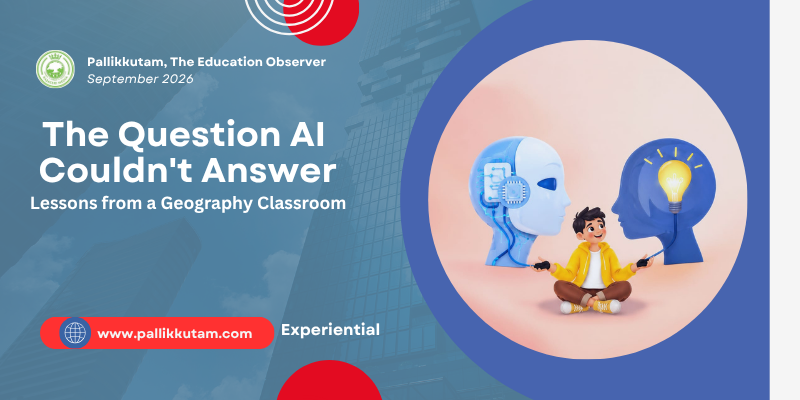
"Sir, let's ask AI."
The suggestion came almost instantly. It was a regular Class XII Geography lesson on Population Distribution, Density and Growth. Instead of beginning with definitions from the textbook, I wrote a simple question on the board: "Why do millions of people continue to live in places that are highly vulnerable to natural disasters?" Before anyone attempted to answer, one student smiled confidently and said, "Sir, let's ask AI." Within seconds, a well written response appeared on the classroom screen. It explained physical factors, economic opportunities, population pressure and historical settlement patterns. The answer was impressive, accurate, well-structured and grammatically flawless. Many students were satisfied. But I wasn't. I asked another question.
"Does this answer explain why families in Sikkim rebuild their homes after landslides instead of moving away? Does it capture the emotional attachment people have to their land, culture and community? Does it reflect the resilience of mountain people?" The classroom fell silent.
Students began reading the AI response again. This time, they noticed what it lacked. AI had organized facts efficiently, but it had overlooked the local realities that they knew from their own lives. It did not describe the challenges of mountain communities, the influence of culture on settlement decisions or the human emotions connected with place. That silence became the most meaningful moment of the lesson.
It reminded me that Artificial Intelligence can generate information, but only thoughtful learners can transform information into understanding. From Delivering Answers to Inspiring Questions Artificial Intelligence is changing education faster than any previous technological innovation. Students can now generate essays, solve problems, summaries chapters and create presentations within seconds. For teachers, this change is both exciting and challenging.
If information is available instantly, then our role can no longer be limited to providing information. Instead, we must help students analyze evidence, question assumptions, evaluate sources and apply knowledge to real life situations. In today's classrooms, success should not be measured by how quickly students find answers but by how deeply they understand them. This realisation has transformed my teaching philosophy.
Geography: A Subject That Naturally Encourages Thinking
Geography is much more than maps and locations. It helps students understand the relationships between people, places and the environment. Every chapter provides opportunities for inquiry. Why do cities grow? Why do people migrate? Why do disasters affect communities differently? Why does climate change influence livelihoods? These questions rarely have one correct answer. They require observation, discussion, evidence and reflection. This makes Geography an ideal subject for integrating AI without allowing AI to replace thinking.
A New Classroom Routine
Today, my classroom follows a different sequence. Students first observe maps, photographs, satellite images, census data and local case studies. They discuss possible explanations in groups. Only after developing their own ideas do we consult AI. The AI response becomes another source of information not the final answer. Students compare, verify and challenge its conclusions using textbooks, government reports, local examples and their own observations.
Instead of asking, "What did AI say?" they begin asking, "Is AI correct?" That small shift changes everything.
The THINK Framework
Through these experiences, I developed a simple classroom strategy that guides the responsible use of AI.
T: Trigger Curiosity, Begin every lesson with an authentic question rather than an immediate explanation.
H: Harness AI Wisely, Use AI to explore ideas not to replace independent thinking.
I: Investigate Evidence, Verify information using maps, field observations, reliable data and local knowledge.
N: Nurture Discussion, Encourage students to debate, justify opinions and respectfully challenge ideas.
K: Keep Questioning, Help learners understand that every good answer should inspire a better question.
This framework has made my students more confident, reflective and intellectually independent. When AI Meets Local Knowledge One classroom activity became particularly memorable. Students were asked to describe their own village before consulting AI. They observed settlement patterns, agricultural practices, water sources, transportation facilities and environmental challenges.
Afterward, they asked AI to describe the same place. The comparison surprised them.AI described the geography accurately but failed to capture local traditions, community resilience, and indigenous knowledge and lived experiences. Students concluded that technology is powerful but local observation remains indispensable. That lesson taught them something no textbook could. Preparing Learners for an Uncertain Future the world our students will enter is changing rapidly. Many future careers will require collaboration with Artificial Intelligence. However, employers and societies will continue to value qualities that machines cannot easily replicate critical thinking, creativity, empathy, ethical judgement and effective communication. Schools therefore have an important responsibility. Our classrooms must become places where students learn not only to use technology but also to question it responsibly.AI should support learning, not replace curiosity.
Five Practical Ideas for Teachers
From my own classroom experience, I have found these practices particularly effective:
Ask students to solve a problem before using AI.
Encourage them to compare AI responses with local examples.
Teach students to verify information using reliable sources.
Reward thoughtful questions as much as correct answers.
End every lesson with reflection rather than memorization.
These simple strategies require no expensive technology, yet they significantly improve critical thinking.
Conclusion:
The Question That Matters Most Artificial Intelligence is undoubtedly transforming education. It can explain concepts, organise information and support learning in remarkable ways. But it cannot replace a teacher who inspires curiosity. It cannot replace students who observe carefully, think critically and ask meaningful questions. As educators, our greatest responsibility is not preparing students to compete with Artificial Intelligence. It is preparing them to think beyond it.
Because in the end, education will not be remembered for the speed with which students found answers. It will be remembered for the courage with which they asked questions that no machine could answer. "AI may provide information, but wisdom begins when learners question, reflect and connect knowledge with human experience."


SUBMIT REVIEW
Please email us: editor.rajagirimedia@gmail.com
A database error occurred.