
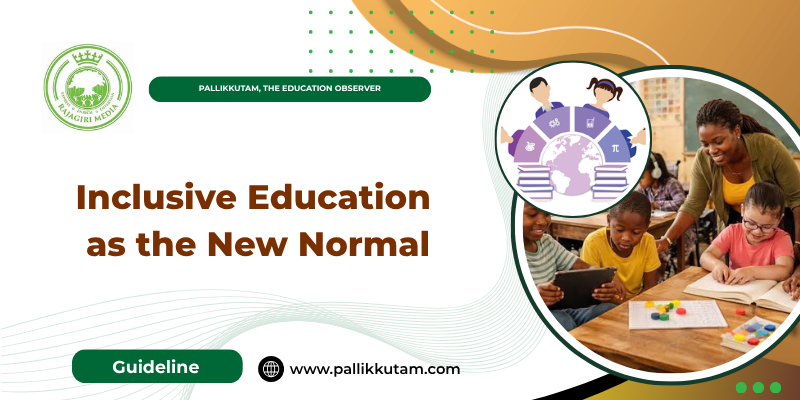
The world has spent decades trying to make education inclusive, yet exclusion remains a defining reality. In 2024, 273 million children, adolescents and young people were out of school, about one in six of the world’s school-age population. Exclusion also persists within schools, where physical, psychological, cognitive, social and financial barriers restrict meaningful participation. Inclusion has therefore been pursued largely as a right, a social responsibility and often a legislative obligation. The AI age presents a counter-intuitive possibility: inclusion can move from something education is required to provide, to something education fundamentally needs in order to remain human.
AI-native education changes the purpose of learning. As AI assumes more cognitive tasks, education must cultivate capacities that complement machine intelligence rather than compete with it. Its deeper mission is to develop AI-complementary ways of being, thinking, doing and being-together. These capacities cannot emerge through personalised instruction alone. They grow through encounters and shared experience. Differences inherent in diversity challenge assumptions, enlarge perspectives and call forth empathy, collaboration and responsibility. A diverse learning community therefore becomes not a concession to difference, but a formative environment for human intelligence in the AI age.
This requires a radical rewriting of inclusion. An inclusive classroom cannot remain a standard environment modified to accommodate those who fall outside a presumed norm. The norm itself must change. Every learner brings distinctive abilities, experiences, circumstances and ways of seeing. When such differences meet, learners encounter realities that cannot be reduced to information delivered by a machine. They learn to listen, understand, disagree, collaborate and construct meaning together. Inclusion thus offers a pedagogy through which learners discover the complexity of being human.
It is also where AI-resilience is cultivated. The AI-resilient learner does not try to outperform machines on their strongest terrain, but develops capacities that become more valuable as machines become more capable. Radical empathy enables human connection. Real-life problem solving connects knowledge with uncertainty and consequence. An entrepreneurial bend of mind turns challenges into possibilities and purposeful action. Such qualities are formed through participation in diverse communities where learners learn with others, contribute to others and assume responsibility for a shared world.
This is why inclusive education must become the new normal. “Normal” education can no longer mean educating a presumed average learner and making exceptions for everyone else. In the AI age, diversity itself must become the ordinary condition around which education is designed. The decisive question is therefore not merely, “How can we personalise learning for every learner?” but, “How can every learner belong, participate and contribute?” AI can personalise instruction; inclusion humanises education. What legislation once demanded as an obligation, the AI age reveals as a condition of excellence. Inclusion becomes the new normal when difference is no longer accommodated at the margins, but recognised as the very environment in which human beings learn to become fully human.
 Dr. Varghese Panthalookaran

SUBMIT REVIEW
Please email us: editor.rajagirimedia@gmail.com